

Every relationship begins with a first encounter, a first impression. This applies to private as well as business. Sometimes the image of “ice breaking” is used when talking about the first trust-building steps at the beginning of a relationship. To stay in the picture of the ice: at the beginning the ice is still very thin and does not carry, or only very little.
The interlocutor has – depending on the respective role of the two interlocutors – certain expectations of how he will be addressed, what the other person may say or what he or she may ask – or even demand.
When interaction begins, a social game begins, the rules of which one cannot talk about – at least not with the one directly opposite, which is part of the game – and therefore in every new game one has to use one’s intuition and instinct for every new game partner to approach the „rule variants“.
The aim of the game is to be seen as trustworthy and as a potential partner. The meaning of the term partner depends on the context of the respective social interaction. If I open the contact too cautiously or hesitantly, then the other person may perceive me as fearful or even weak. If, on the other hand, I appear too dominant and too decisive, then there is a risk of overwhelming or frightening conversation partners.
The channel of acceptance stretches between these two extremes. In the middle of the channel of acceptance, there is eye level for both. If I leave the channel of acceptance, the interaction is ending and everything that follows will be courtesy owed to the upbringing.
If I leave the acceptance channel downwards, then I am a pure waste of time and not helpful for the business partner. If I am in the upper half of the acceptance channel, then the other person has to accept one or two unreasonable demands, but in a dose that they can tolerate and their interest in continuing the interaction outweighs them. Depending on the context, this imposition can be part of a negotiation of terms and conditions or simply an openness (“impertinence”?) In communication that this person is otherwise not used to or that is perhaps unusual for the respective context.
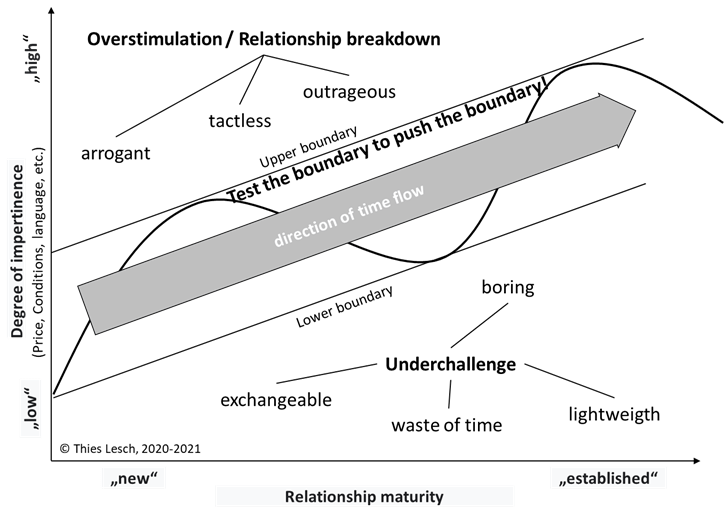
In a relationship – and a regularly recurring interaction is one – there is a certain learning effect. The parties know each other, they trust each other or know where they cannot, want or should trust each other (can, want or are allowed to) and have stable, experience-tested mutual expectations.
This means that over time, both of them remain more and more in their comfort zone during the interaction – unless new stimuli are set.
For this reason, it is the task of every relationship manager and customer service representative to test the upper limits in the acceptance channel with his customers in order to shift the limits. If the customer is used to courage, he can only be impressed with even more courage.
By shifting the boundaries in the acceptance channel, the consultant gains respect, format and relevance for his customers. And it is clear that the higher the acceptance threshold, the easier it is for me as a consultant to address issues that, in case of doubt, will not even be entrusted to my best friend.
PS: I thank Marc Laubsch (Marc Laubsch Training and Coaching, 22087 Hamburg) for this model and the inspiration for this text.
 Vertriebsmanagement
Ein Kommentar zu “Working in the channel of acceptance”